
Downsizing in Retirement: Is it Right for You?
For many retirees, the family home is more than a place to live. It is the place your children grew up, where you celebrated birthdays and life events, where family gathered for the holidays, where neighbors became friends, and where routines took shape over decades. So, when the idea of downsizing comes up, it’s rarely just a real estate decision. It can affect your finances, your lifestyle, your family relationships, and the comfort of home.
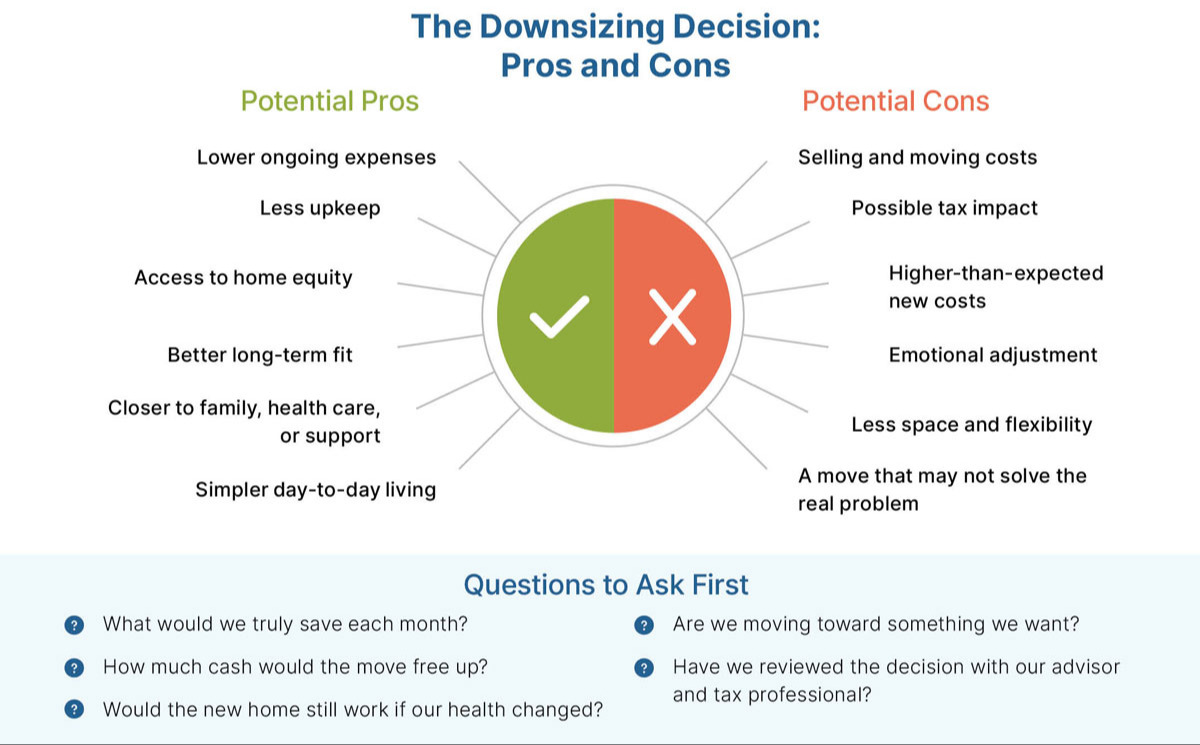
Moving to a smaller place can be a smart move for some retirees, but it’s not automatically the right one. Having less space may reduce expenses and upkeep, but it can also come with selling costs, taxes, emotional adjustments, and new tradeoffs. Before you decide, it helps to look at what you hope to gain, what you may give up, and whether the move supports the life you want in retirement.
Why Some Retirees Choose to Downsize
Retirees often consider downsizing because their current home no longer fits the way they live. A house that once made sense for a busy family may now feel too large, too costly, or too difficult to maintain. Empty bedrooms, steep stairs, a large yard, or ongoing repairs can become more of a burden than a benefit. To decide if moving to a smaller home is right for you, first assess your main goal.
If the goal is lower monthly costs
A smaller home may reduce utilities, maintenance, insurance, and property taxes, depending on location. For retirees living on a planned income, lowering regular expenses can help make cash flow more manageable. The most useful first step is to compare your current monthly housing costs with a realistic estimate for the new home, not just the new mortgage or purchase price.
If the goal is less upkeep
For retirees more interested in saving time and energy, a smaller home, condominium, townhome, or retirement community may mean fewer repairs, less yardwork, and fewer household responsibilities. If maintenance is the main concern, list the tasks that feel hardest now. Then ask whether a move would truly solve those issues or whether hired help, home updates, or a different type of support could address them.
If the goal is accessing home equity
Home equity is the difference between what your home is worth and what you still owe on it. If you sell your current home and buy a less expensive one, you may free up cash that can support retirement income, build an emergency fund, pay down debt, or fund other goals. But the amount available may be lower than expected after factoring in selling costs, moving expenses, taxes, and the cost of the next home.
If the goal is a better location
Some retirees move to be closer to adult children, grandchildren, friends, health care, public transportation, or activities they enjoy. Others want a home that may be easier to navigate later, such as one with fewer stairs, a first-floor bedroom, or a step-free entrance. In this case, the move is not only about size. It’s about choosing a home and community that will better fit your next stage of life.
Financial Benefits Vs. Hidden Costs
The financial case for downsizing can seem appealing, but it should be tested carefully. Smaller doesn’t always mean cheaper, especially in areas where ranch-style homes, condos, or homes near family and services are in high demand.
Selling costs can reduce the proceeds
Start by estimating what it may cost to sell your current home. Common expenses include real estate commissions, legal fees, transfer taxes, repairs, staging, inspections, and moving costs. If you are buying another home, include closing costs, new furniture, renovations, storage, and any updates you may want to make for safety or accessibility.
New costs may replace old ones
A smaller home may lower some bills, but it can add others. Condo fees, homeowners association dues, special assessments, parking fees, community fees, or higher insurance costs can offset some of the expected savings. Property taxes may also change if you move to a different town or state. Before deciding, compare the full cost of staying with the full cost of moving.
Taxes may affect the outcome
If your home has increased in value, taxes may also matter. Some homeowners may qualify to exclude up to $250,000 of capital gain from the sale of a primary residence, or up to $500,000 for married couples filing jointly, if they meet IRS rules (Publication 523). A capital gain is the profit from the sale. In simple terms, it is the sale price minus what you paid for the home, adjusted for certain items such as qualifying improvements. The calculation can be more complex if you inherited the home, used part of it as a rental, or don’t have records of improvements. A tax professional can help estimate whether any gain may be taxable.
One-year income changes can have ripple effects
If part of the home sale gain is taxable, it may increase your income for that year. For retirees on Medicare, higher income can sometimes lead to higher Part B and Part D premiums through an income-related surcharge called IRMAA. This doesn’t mean selling is a mistake. It means timing, taxes, and Medicare costs should be reviewed together before the sale, especially if you are already near a higher-income threshold.
Lifestyle and Emotional Considerations
The financial benefits and costs are only part of the decision. A home’s emotional value can be difficult to measure, as leaving a familiar neighborhood, a garden, a workshop, or the place where family gathers can feel like a loss, even when the move makes practical sense.
The emotional side of leaving home
It can help to separate the house from the memories. Consider taking photos, saving a few meaningful items, or involving family in the transition. If adult children have strong feelings about the home, it may be worth discussing the decision early, while making clear that the choice needs to support your retirement.
How the new home fits daily life
Picture an ordinary week, not just the ideal version of retirement. Where will you buy groceries? How far is medical care? Will you have enough space for guests, hobbies, pets, or storage? If you are moving to a condo or community, are you comfortable with shared rules, fees, and association decisions?
Planning for future needs
A good home for retirement should work for your life now and remain practical as your needs change. Think about stairs, bathroom access, laundry, parking, lighting, walkability, and how easy it would be to get help if driving became difficult. A home that’s smaller but harder to navigate may not be a better long-term fit.
Alternatives to Downsizing
Selling may be the right answer, but it’s not the only option.
Modify the current home
Some retirees choose to stay put and make the home easier to manage. This may include adding grab bars, improving lighting, moving laundry to the main floor, creating a first-floor bedroom, simplifying unused rooms, or hiring help for yardwork and repairs.
Rightsized instead of downsized
Rightsizing means choosing the home that best fits your life, even if it is not dramatically smaller. For one person, that may mean a condo near family. For another, it may mean a similar-sized home with fewer stairs and less land.
Rent before buying
If you are considering a new town, state, or retirement community, renting first may help you test the location before committing. This can be especially helpful if you are moving to be closer to family or trying a different lifestyle.
Explore home equity options carefully
Some homeowners consider a home equity line of credit, reverse mortgage, or other strategy to access home value without selling. These options can involve fees, interest, eligibility rules, and long-term effects on your estate, so they should be reviewed carefully before moving forward.
A Decision Worth Planning For
Downsizing can simplify life, reduce expenses, and help a home better match your retirement needs. It can also be more costly, emotional, and complicated than it first appears.
Before deciding, gather real numbers. Estimate your sale price, selling costs, tax impact, moving expenses, and the full cost of the next home. Then compare those figures with your retirement income plan, health care needs, family priorities, and estate goals.
The right decision is not simply the one with the smaller floor plan. It is the one that helps you feel more prepared, more comfortable, and better supported in the years ahead.


